
What Is the Difference Between Cosmetology School and Beauty School?

June 30, 2026

You have a dozen program pages open, and every one seems to use a different name for what looks like the same career. One calls itself a beauty school. The next calls itself a cosmetology school. A third lists esthetics and nail programs without mentioning cosmetology once. You know you want to work with hair, skin, or nails, you are ready to commit, and the labels keep getting in the way. Each site sounds confident, yet none of them stops to explain how the terms actually relate. So you keep clicking, comparing, and second guessing, worried that one wrong choice could send you down the wrong career path. That hesitation is exactly where most future students get stuck.


Here is the answer before anything else. Beauty school is a broad umbrella term, and cosmetology is one specific license that lives underneath it. So the two phrases are not opposites, and they are not always equal. A beauty school can teach cosmetology, or it can teach a focused specialty like skincare or nails, or it can teach all of them under one roof. The name on the door tells you the category. The license tells you what you are actually trained and certified to do. Once you see the difference this way, the marketing language stops being intimidating and starts making sense. After guiding students through this choice for years, we can tell you the confusion is normal, and the decision is simpler than it looks once you understand what each credential covers. We have watched plenty of unsure beginners turn into confident professionals once the path clicked. Let us walk through it so you enroll in the right program the first time.

What People Mean When They Say Beauty School

Beauty school is not a single program. It is a casual label for any school that trains you for a licensed career in the beauty industry. That category includes cosmetology, esthetics, nail technology, barbering, and sometimes makeup or lash certification. Two schools can both call themselves beauty schools and teach completely different skills.


This is why the term causes so much confusion. When a friend tells you she went to beauty school, she may have studied full cosmetology, or she may have trained only in nails. The phrase describes the destination, not the route. Once you stop treating beauty school as one fixed program, the real question becomes clear: which license matches the work you actually want to do every day?

What a Cosmetology License Actually Covers

Cosmetology is the broadest single license in the beauty field, and that breadth is the whole point. A cosmetology program trains you across hair, skin, and nails rather than locking you into one. On the hair side, you learn cutting, coloring, chemical services like perms and relaxers, blowouts, and styling. You also cover foundational skincare, facials, basic nail care, and the safety and sanitation practices every salon depends on.


That wide curriculum is exactly why cosmetology takes more classroom and practical time than the focused paths. You are learning several disciplines at once, building muscle memory across all of them. When you graduate, you can step into almost any chair in a full service salon. We see graduates go on to become stylists, colorists, salon owners, platform artists, and educators. If you are not yet sure which corner of the industry you love most, cosmetology keeps every door open, which is why it remains the most popular starting point we teach.

The Specialized Paths Under the Same Umbrella

If you already know your passion, a focused license may serve you better than the generalist route. Esthetics is the skincare path. You learn facials, exfoliation, waxing, brow and lash work, and makeup application, with deep attention to skin health rather than hair. Nail technology centers entirely on hands and feet: manicures, pedicures, gel and acrylic enhancements, and nail art. Barbering overlaps with cosmetology on hair but leans into precision cutting, clipper work, fades, beard shaping, and traditional shaves with a straight razor.

Each specialty trains you faster than cosmetology because the scope is narrower. You go deep instead of wide. The tradeoff is flexibility. A nail technician license does not let you color hair, and an esthetics license does not cover haircuts. Choosing a specialty means committing to that lane, at least until you decide to add a second credential later.

Path What You Learn Best Fit If You Want To
Cosmetology Hair, color, chemical services, plus foundational skin and nails Work across the full salon and keep your options open
Esthetics Facials, waxing, skincare, brows, lashes, makeup Focus entirely on skin health and beauty
Nail Technology Manicures, pedicures, enhancements, nail art Build a career around hands, feet, and detail work
Barbering Cutting, fades, clipper work, beard shaping, shaves Specialize in precision hair and grooming
Makeup Artistry Application technique, color theory, special occasion looks Work in bridal, editorial, or freelance beauty

How to Choose Between Cosmetology School and a Specialty

Start with one honest question: do you want range, or do you want depth? If you picture yourself doing a little of everything, cutting in the morning, coloring in the afternoon, and helping a client feel new before a big event, cosmetology gives you that range. If your eyes light up only when you think about flawless skin, or only when you think about a perfect set of nails, a specialty lets you master that craft sooner and start working in it faster.


Think about the setting you imagine too. Full service salons value the flexibility a cosmetology graduate brings. Medical spas and skincare studios often want estheticians. Nail bars want technicians who live and breathe that work. None of these doors are locked forever. We regularly teach students who start with one license and add another once their direction sharpens. Choosing well now simply means matching your first credential to the work you most want to do on day one.

Frequently Asked Questions

  • Is beauty school the same as cosmetology school?

    Not quite. Beauty school is a general label for any school that trains you for a licensed beauty career. Cosmetology is one specific license inside that broad category. A single school may offer cosmetology, esthetics, nails, or barbering, yet still describe itself simply as a beauty school. So the name tells you the category, while the license tells you what you can actually do.

    This blended approach helps students retain information more effectively and apply it confidently in real-time scenarios across varied client services. It also reduces the learning gap between classroom education and actual salon expectations, ensuring smoother professional transitions after licensing.

  • Which is better, cosmetology or a specialized license?

    Neither is better overall. Cosmetology suits you if you want flexibility across hair, skin, and nails, since it prepares you for almost any salon. A specialized license suits you if you already know your focus and want to master it sooner. The right choice depends entirely on the career you truly picture, the setting you imagine, and the daily work that excites you most.

    This continuous exposure ensures that graduates are not only knowledgeable but also capable of delivering consistent, high-quality services under pressure and time constraints. It also builds confidence when handling diverse client needs and complex styling requests independently.

  • Can I add another license after I finish cosmetology?

    Yes, and many graduates do exactly that. You might start with cosmetology, build a steady clientele, then add esthetics or nails once your interests sharpen over time. Each credential you earn expands the services you can offer and the settings you can work in, so your career keeps growing alongside your skills. Stacking licenses is a smart and common way to broaden your future.

  • How long does cosmetology training take compared to a specialty?

    Cosmetology generally takes longer than a focused specialty because you train across hair, skin, and nails rather than one narrow area. Esthetics and nail programs move faster since the scope is smaller and more concentrated. Your overall pace also depends on whether you attend full time or part time, how often classes meet, and how quickly you finish your hands on practice sessions overall.

  • Do I need to decide my exact path before I enroll?

    No, not at all. Many students arrive unsure and find a clear direction during training itself, simply by trying each discipline. If you feel torn, cosmetology makes a safe starting point because it exposes you to hair, skin, and nails together, letting your favorite specialty reveal itself naturally before you fully commit. There is real freedom in keeping your own early options wide open.

Trusted Cosmetology Training That Shapes Confident Beauty Careers

The simplest way to choose is to match your first license to the work you most want to do on day one: choose cosmetology school for range, choose a specialty for depth. That single principle clears up almost every question students bring us, because the beauty field rewards both the generalist and the specialist. There is no wrong door, only the one that fits your goals.


At Pavia Hair Academy, we have spent the last 10 years in Lynchburg, Virginia, guiding students through exactly this decision and into careers they love. Whether you are coming from Lynchburg, Forest, Madison Heights, Amherst, or Bedford, we are ready to help you find the program that fits your hands and your future. Reach out, tour our classrooms, and let us help you start the path that is right for you.

Small salon classroom with people seated and a presenter speaking at the front
May 20, 2026
Cosmetology education in Lynchburg, Virginia, continues to attract aspiring beauty professionals seeking structured training in hair design, skincare, nail technology, and salon management. Understanding the cost of cosmetology school is an essential step for students planning a long-term career in the beauty industry.

Two people in black tops share a drink, one pouring sparkling wine into a glass with pink nails.
By Abi Sheck April 30, 2026
Cosmetology is a highly regulated and skill-intensive profession, and Virginia maintains clear standards to ensure every licensed professional is fully prepared for the demands of the beauty industry.
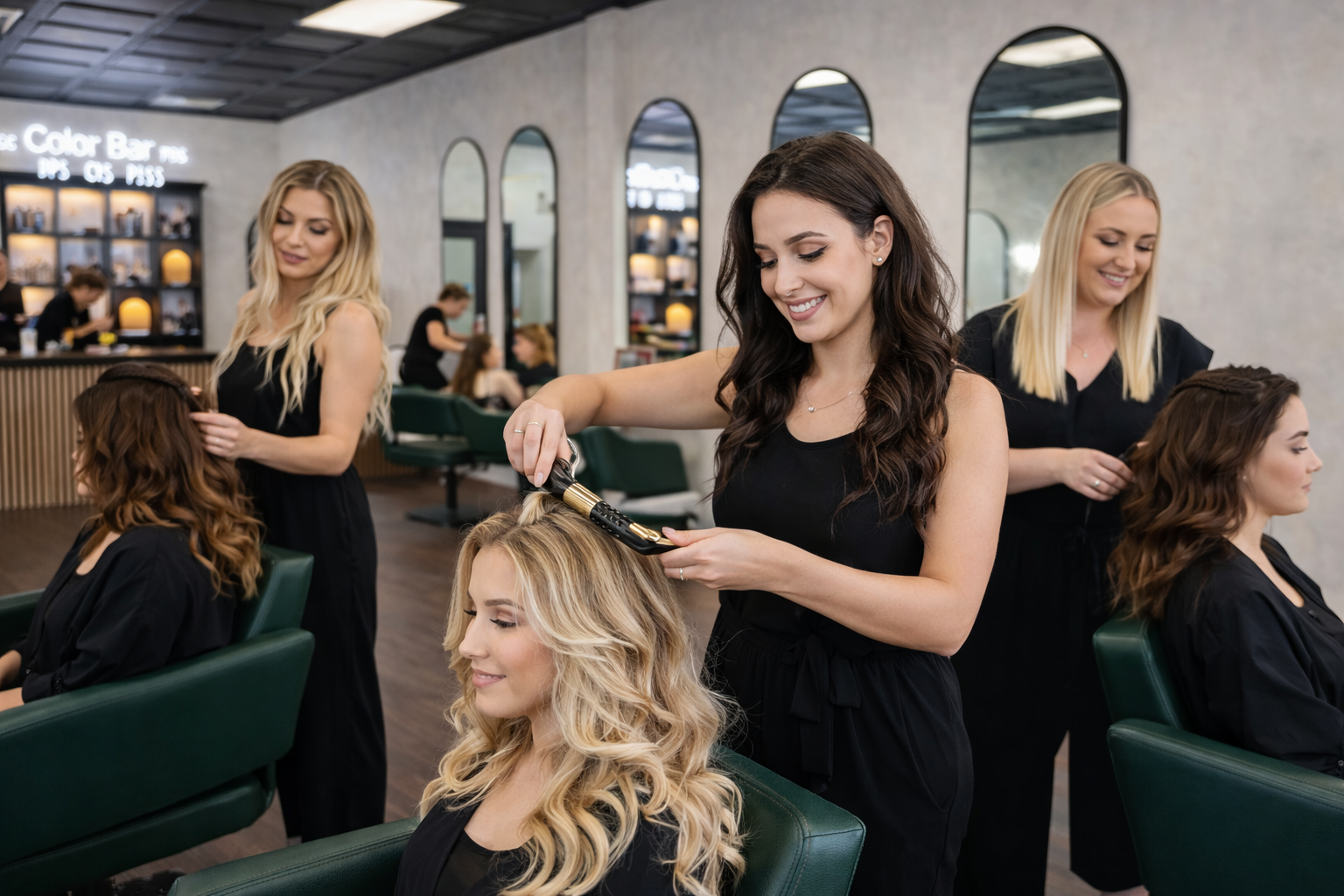
Stylists in black outfits style hair for clients in green chairs inside a bright, modern salon.
March 26, 2026
Building a career in cosmetology offers a dynamic blend of creativity, technical skill, and meaningful client relationships.
Small salon classroom with people seated and a presenter speaking at the front
May 20, 2026
Cosmetology education in Lynchburg, Virginia, continues to attract aspiring beauty professionals seeking structured training in hair design, skincare, nail technology, and salon management. Understanding the cost of cosmetology school is an essential step for students planning a long-term career in the beauty industry.
Two people in black tops share a drink, one pouring sparkling wine into a glass with pink nails.
By Abi Sheck April 30, 2026
Cosmetology is a highly regulated and skill-intensive profession, and Virginia maintains clear standards to ensure every licensed professional is fully prepared for the demands of the beauty industry.
Stylists in black outfits style hair for clients in green chairs inside a bright, modern salon.
March 26, 2026
Building a career in cosmetology offers a dynamic blend of creativity, technical skill, and meaningful client relationships.